Does My Health Insurance Cover Addiction and Mental Health Treatment?
In most cases, health insurance will cover at least a portion of your treatment.
Home > Insurance
In most cases, health insurance will cover at least a portion of your substance use or mental health disorder treatment. For some individuals, it will cover the entire cost of treatment services. Some insurance companies may only cover treatment at specific facilities, while others may provide coverage for a wider range of options. It’s important to check with your insurance provider to find out what types of treatment are covered under your policy.
Treatment centers that accept insurance can be found for both inpatient and outpatient treatment settings. Inpatient treatment usually requires a higher level of care, and as such, may have a higher price tag. Outpatient rehab is typically less expensive, but it may not be as effective for those with severe substance or mental health issues. Once again, it’s important to consult with your insurance provider to see what type of treatment is covered under your policy.
You can also contact us here at Live Free Recovery Services. Our team can help you work through the details of your health insurance policy.
The Need for Comprehensive Treatment Options in the United States
According to the National Institute on Drug Abuse, drug and alcohol addiction is a major problem in the United States, with about 20 million people struggling with some form of substance use disorder. The National Institute of Mental Health estimated that as of 2022, more than one in five U.S. adults live with a mental illness. Addiction and mental illness can have a profound impact on every aspect of a person’s life, from their health and relationships to their finances and career.
What’s more, addiction often co-occurs with other mental health conditions, such as depression and anxiety. This can make treatment challenging, as both disorders need to be addressed in order to achieve lasting recovery. In 2020, an estimated 19.2 million adults in the United States lived with a dual diagnosis. Of those adults, only 7.4 million received treatment for both disorders.
Does Health Insurance Cover Substance Use and Mental Health Treatment?
Many individuals worry about treatment costs. Individuals who are impacted by addiction and mental health disorders often struggle with limited finances as well. The cost of treatment can be a significant barrier to people getting the help they need.
Many insurance plans cover the full cost of care or at least offer minimal out-of-pocket expenses. If your insurance only provides partial coverage there are still many resources available to help you get the treatment needed. This includes private pay, payment plans, and personal loan options.
Using Insurance to Cover Treatment

The Affordable Care Act, or ACA, mandates health insurance coverage for addiction treatment and mental health services. This means that finding health insurance that covers treatment is a much simpler process than people may realize.
Individuals who are struggling with substance use or psychiatric problems can receive the treatment they need in order to recover and resume their normal lives. By providing access to quality care, the ACA helps to ensure that no one has to go without the help that they need due to cost concerns.
At the same time, the ACA requires health insurance companies to cover a wide range of addiction-related treatments, including partial hospitalization programs and long-term inpatient care. These may include individual and group therapy sessions, medication-assisted treatment, social support, as well as alternative health approaches such as acupuncture and yoga.
This ensures not only that people have access to effective treatment, but also that they have a wide range of treatment programs to choose from depending on their unique needs and goals.
Does Insurance Cover Dual Diagnosis Treatment?
The Mental Health Parity and Addiction Equity Act (MHPAEA) requires health insurance providers to offer the same level of coverage for mental health services as they do for physical health services (like addiction treatment). This means that if your health insurance plan covers hospitalization for a physical health condition, it must also cover hospitalization for a mental health condition.
However, the MHPAEA does not require health insurance providers to cover all mental health services. If you are seeking treatment for a mental health condition and you have health insurance, you should check with your health insurance to see what treatment options are covered. You may also want to ask about insurance coverage for dual diagnosis treatment, which treats both addiction and mental health disorders.
Does Medicaid Cover Addiction and Mental Health Treatment?
Medicaid is a federal program that provides affordable healthcare coverage to individuals, including those with a history of substance use. In most states, the Medicaid program covers the full cost of addiction or mental health treatment, including an inpatient or outpatient rehab center as well as medication-assisted treatment.
If you are struggling with a substance use or mental health disorder, or both, or know someone who is, Medicaid can help to ensure that you get access to a high-quality treatment program that gives you the best chance of recovery.
At Live Free Recovery, we offer treatment using New Hampshire Medicaid. Therefore, the cost of treatment may be free, or at a significantly reduced cost. You can contact us today to find out if your specific plan qualifies.
What are “Out-of-Pocket” Expenses in Substance Use or Mental HealthTreatment?
While many types of treatment expenses are covered by insurance plans, there may be additional costs that individuals will have to pay. In general, those who have more comprehensive insurance plans will have lower out-of-pocket costs than those who rely on more limited coverage. These expenses can include:
- Insurance co-pays (sometimes referred to as “coinsurance”): The cost associated with gaining access to a particular service or healthcare provider.
- Deductible: The amount that the insurance carrier pays up to a certain cost before costs are covered by insurance.
- Lifetime limitations: In some policies, insurance coverage is only up to a certain cost and then then the individual must cover the rest of the costs to healthcare providers.
- Premiums: The amount you pay regularly to have an insurance plan.
To be clear, depending on the treatment center and the insurance plan, the cost of treatment will vary.
What Types of Insurance Plans Does Live Free Accept?
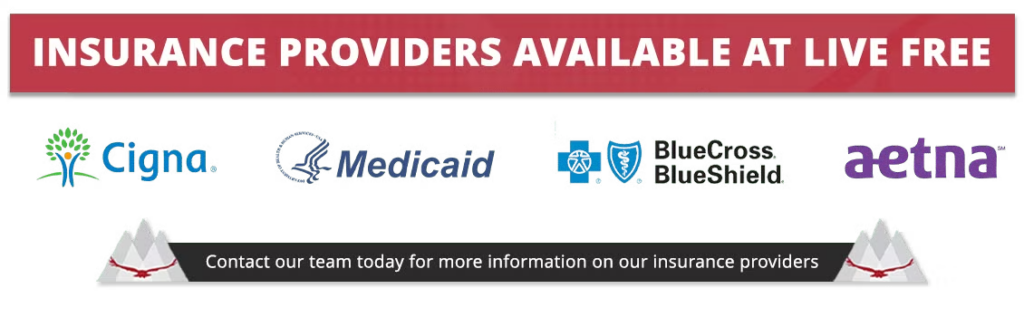
Here at Live Free Recovery Services, we accept various types of health insurance that cover substance use or mental health disorder treatment. If you have a policy with any of the following health insurance companies, contact us, today:
- Aetna (in-network)
- Cigna (in-network)
- Tricare (out-of-network)
- NH Medicaid (in-network)
- Blue Cross Blue Shield (in-network)
We know that it can be challenging to take the first step toward recovery. Concerns about the uncertainty that surrounds addiction and mental health recovery can be debilitating. Fears of not being able to pay for treatment can be daunting. But we are committed to walking with you every step of the way.
By reaching out to our team here at Live Free Recovery Services, you can get the answers you need. You can rest assured that we will make every effort to give you a smooth admission experience. We will discuss the details of your health insurance and work with your insurance company as much as possible so you can simply focus on your recovery!

Take the First Step Towards a Brighter Tomorrow
At Live Free Recovery, we’re committed to walking alongside you on every step of your journey. Our compassionate team is here to provide the guidance and support you need to overcome addiction, mental health disorders, and co-occurring disorders so you can reclaim your life. Don’t wait—reach out today to speak with someone who truly understands your struggles and can help you take that important first step toward healing and a fresh start.
Your path to recovery starts here.